“LOOK OUTSIDE, JEFF!” — TERRIFYING FINAL RADIO CALLS REVEAL LEARJET’S 60-DEGREE BANK AND 22,000-FEET-PER-MINUTE DESCENT BEFORE diᩚadℓy FLORIDA 𝔠r𝘢sh
Newly released air traffic control recordings have exposed the terrifying final moments of a private jet that plunged out of control over Florida, 𝘬iᩚlling all nine people aboard. Aviation experts are now examining whether the crew suffered spatial disorientation or whether a catastrophic structural failure caused the aircraft to become uncontrollable.
GREENACRES, FLORIDA — The final radio transmissions from a doomed Learjet 60 have revealed a desperate struggle to save the aircraft as it spiralled towards the ground near a residential community in Palm Beach County.
The tᩚraɢedy happened on November 1, 2026, when chartered Learjet 60 N722BD crashed near Greenacres, Florida, during a flight from Austin, Texas, to North Eleuthera in the Bahamas.
All nine people aboard — two pilots and seven passengers — were killed.
Among the victims was 20-year-old co-pilot Nathalia Gadelha Filgueiras, a young aviator who had earned her private pilot’s licence at just 17.
The aircraft was captained by 55-year-old Jeffrey Gregory.
Now, recordings of the crew’s final communications with air traffic controllers are providing investigators and aviation specialists with a disturbing insight into what happened inside the cockpit.
The transmissions describe accumulating ice, moderate turbulence, an extraordinary rate of descent and a banking angle of approximately 60 degrees.
But one of the most haunting moments came when Nathalia repeatedly urged her captain to look outside.
“Look outside, Jeff, look outside,” she shouted.
Moments later, she delivered another desperate message:
“We’re out of time.”
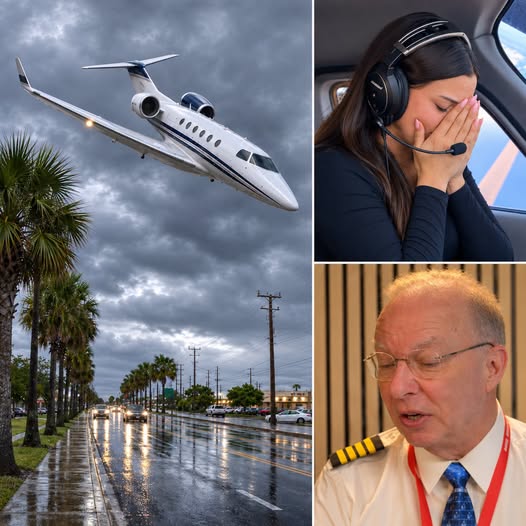 THE FLIGHT THAT TURNED INTO A NIGHTMARE
The Learjet 60 was travelling at approximately 35,000 feet when the crew began reporting difficult weather conditions.
At around 12:47 p.m. local time, Nathalia contacted Miami air traffic control and reported light clear icing and moderate turbulence.
The aircraft was experiencing fluctuations in altitude, with the co-pilot reporting changes of several hundred feet.
The crew asked about the possibility of finding smoother air.
The air traffic controller reassured them that conditions were expected to improve farther along their route.
However, the situation soon deteriorated.
As the aircraft encountered precipitation, the crew requested permission to climb from 35,000 feet to 37,000 feet.
Air traffic control approved the request.
But within seconds, the flight entered a catastrophic descent.
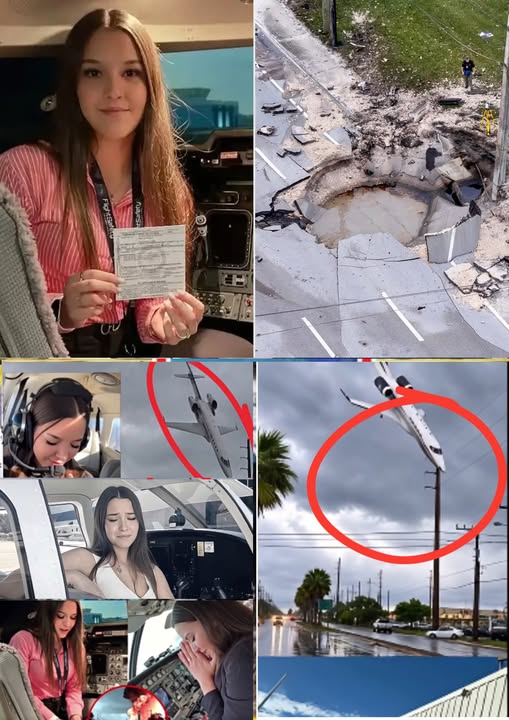 “MAYDAY, MAYDAY” — THE TERRIFYING DESCENT
The first emergency transmission came with an alarming report from the cockpit.
“722 Bravo Delta, we’re descending 8,000 — mayday, mayday — we’re descending 10,000 feet per minute.”
The controller immediately responded, attempting to establish what was happening.
But the aircraft appeared to be accelerating downward at an extraordinary rate.
Nathalia then reported that the Learjet was experiencing an overspeed condition, with its descent rate reaching approximately 20,000 feet per minute.
In another transmission, she warned:
“We’re gonna 𝔠r𝘢sh into the ground, 722 Bravo Delta.”
The controller continued trying to communicate with the aircraft, asking the crew to explain their situation.
Then came another chilling report.
“We are descending 22,000 feet, and we are banking 60 degrees,” Nathalia said.
Her voice sounded increasingly distressed.
In the background, another voice appeared to be reciting the Lord’s Prayer.
Investigators and journalists have described the final seconds as an extraordinary sequence of increasingly desperate radio calls.
Nathalia’s repeated instruction to her captain to look outside has become one of the most discussed details of the recording.
What exactly was she seeing?
And why was the aircraft descending so rapidly?
Those are among the questions investigators are trying to answer.
SPATIAL DISORIENTATION: COULD THE PILOTS HAVE LOST THEIR SENSE OF DIRECTION?
One possible explanation being discussed by aviation specialists is spatial disorientation.
This is a dangerous condition in which pilots can lose their reliable sense of an aircraft’s position, movement or orientation.
The human inner ear is not always capable of accurately detecting aircraft movement, particularly during unusual manoeuvres, turbulence or rapid changes in attitude.
In certain circumstances, a pilot may believe the aircraft is level when it is banking, or may struggle to recognise the direction and severity of a developing descent.
Severe weather can make the problem even more difficult.
When visibility is reduced by clouds, precipitation or darkness, pilots may have fewer reliable external visual references.
The instruction “Look outside, Jeff” has therefore attracted attention from aviation observers.
Some have suggested that Nathalia may have been attempting to establish a visual reference to help overcome possible spatial disorientation.
However, the words alone cannot establish that either pilot was suffering from this condition.
It is also possible that she was attempting to draw attention to something visible on the aircraft or in its surroundings.
Only a detailed examination of the cockpit recordings, flight data and physical evidence can help determine what the crew were experiencing.
A SECOND POSSIBILITY: DID THE AIRCRAFT SUFFER A CATASTROPHIC STRUCTURAL FAILURE?
Another major line of investigation concerns the possibility that parts of the aircraft’s structure separated during flight.
The National Transportation Safety Board (NTSB) previously confirmed that investigators had recovered aircraft components some distance from the main impact site.
Among the recovered components were sections of the left elevator, a ᑕriᩚtiᩚcal flight-control surface attached to the aircraft’s tail.
The elevator helps control the aircraft’s pitch — its nose-up and nose-down movement.
Three pieces of the left elevator were reportedly found between approximately 1.3 and 3.8 miles from the 𝔠r𝘢sh site.
Investigators also recovered components from the wings, engines, vertical stabilizer, horizontal stabilizer and other flight-control systems.
These discoveries have raised important questions about whether the aircraft began breaking apart before hitting the ground.
A structural failure involving ᑕriᩚtiᩚcal flight-control components could severely affect a pilot’s ability to control the aircraft.
However, investigators must establish whether any components separated before the loss of control or were damaged by the extreme forces experienced during the descent.
The distinction is crucial.
Finding aircraft debris away from the impact site does not, by itself, prove what caused the aircraft to break apart.
ICE, TURBULENCE AND OVERSPEED: WHAT ROLE DID THE WEATHER PLAY?
Weather conditions are another central part of the investigation.
Before the emergency, the crew reported light clear icing and moderate turbulence.
They also reported encountering precipitation before requesting a higher cruising altitude.
Icing occurs when supercooled water droplets freeze on aircraft surfaces.
Depending on where and how much ice accumulates, it can affect aerodynamic performance, increase drag and alter the airflow over wings and control surfaces.
Severe turbulence can also place significant forces on an aircraft.
Aviation specialists have therefore raised questions about whether the combination of weather conditions and aircraft performance contributed to the emergency.
The reported overspeed condition is particularly important.
An aircraft travelling beyond its permitted operating speed can experience dangerous aerodynamic and structural loads.
If an aircraft is already encountering severe turbulence or experiencing a control-system problem, those forces may make an existing emergency even more difficult to manage.
However, the NTSB has not established whether icing, turbulence, overspeed or a mechanical failure was responsible for the 𝔠r𝘢sh.
It remains possible that several factors contributed to the accident.
THE 20-YEAR-OLD CO-PILOT WHO ACHIEVED HER DREAM AT JUST 17
Away from the technical investigation, the tᩚraɢedy has left families and communities mourning nine lives lost.
Nathalia G