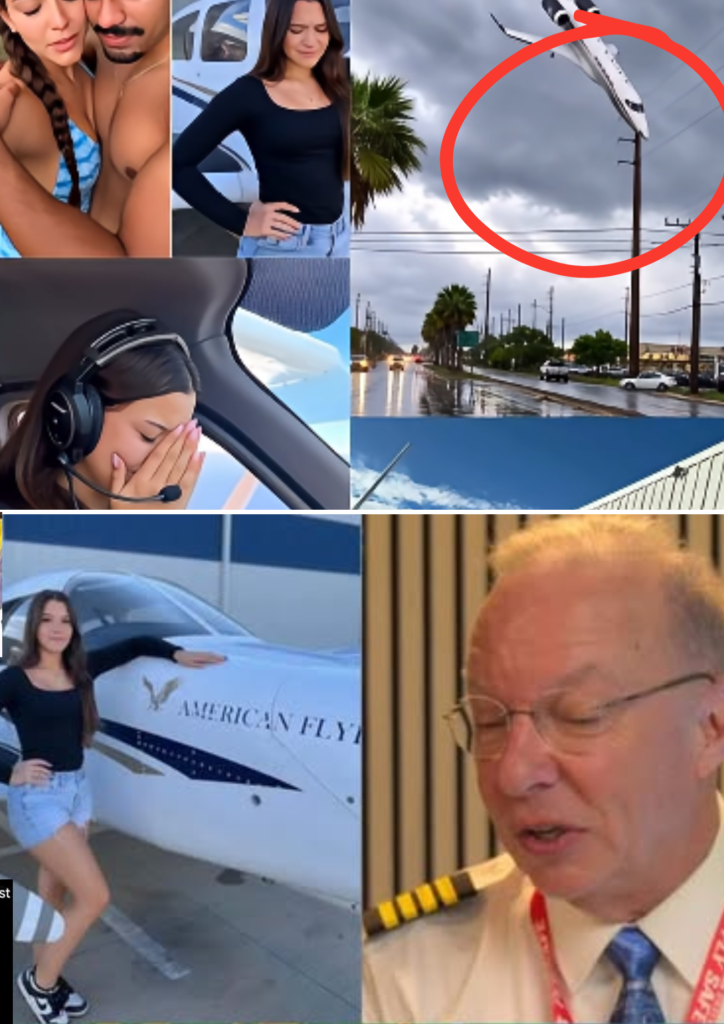
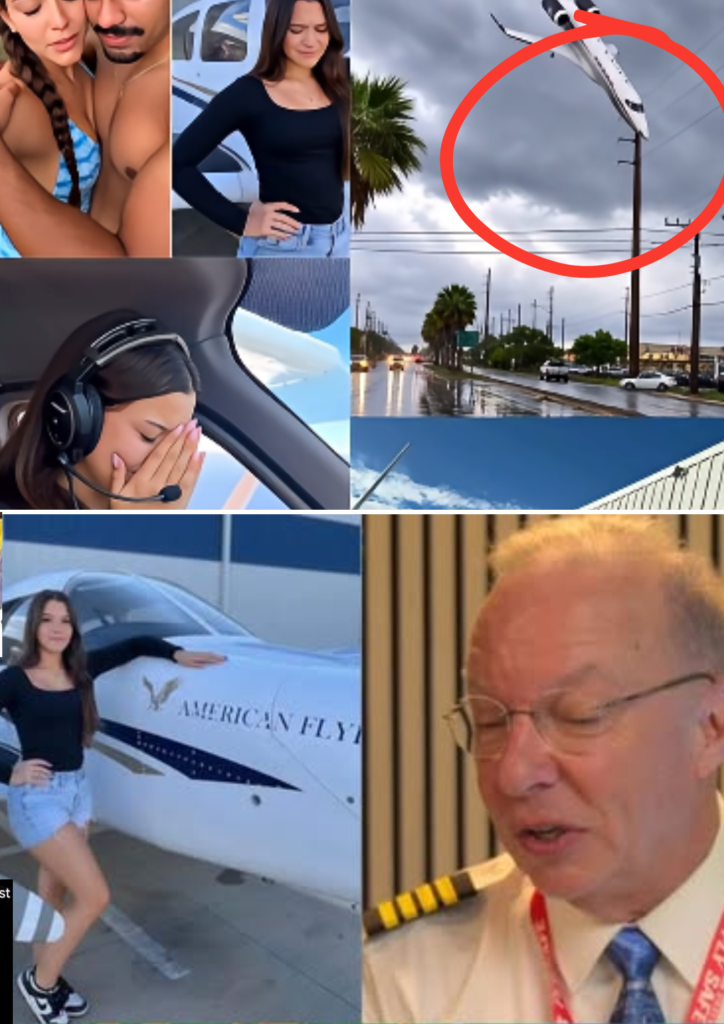
“LOOK OUTSIDE, JEFF!” — THE CO-PILOT’S HAUNTING FINAL PLEA BEFORE FATAL LEARJET 𝔠r𝘢sh RAISES QUESTIONS ABOUT A TERRIFYING COCKPIT EMERGENCY
“Look outside, Jeff. Look outside.”
Those five words have become one of the most haunting moments in the investigation into a fatal Learjet 60 𝔠r𝘢sh in Florida.
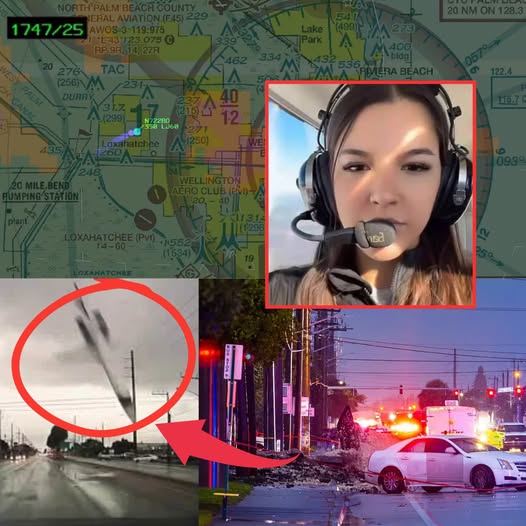
They were heard in the final moments of radio communications involving First Officer Nathalia Gadelha Filgueiras, 20, and Captain Jeff Gregory, 55, as their aircraft plunged thousands of feet toward the ground.
The Bahamas-bound business jet, registered as N722BD, had been flying at approximately 35,000 feet when the crew suddenly reported a terrifying loss of altitude.
There were nine people aboard.
None survived.
Now, aviation experts are examining the aircraft’s final radio transmissions, flight-tracking data, weather conditions and recovered wreckage to understand what happened inside the cockpit.
But one question continues to stand out: Why was Nathalia repeatedly urging the captain to look outside?
 A ROUTINE FLIGHT THAT TURNED INTO A NIGHTMARE
On November 1, 2026, the Learjet 60 departed Austin-Bergstrom International Airport in Texas, bound for North Eleuthera Airport in the Bahamas.
The aircraft was operated by Aurora Aviation, doing business as Upper Jet.
On board were two pilots and seven passengers, including technology entrepreneur Adam Robinson, his wife Helen, their two young daughters, a nanny and two family friends.
The flight initially proceeded without any publicly reported emergency.
However, as the aircraft approached Florida, the crew began encountering increasingly difficult weather conditions.
Nathalia communicated with Miami air traffic control, reporting moderate turbulence and ice accumulation on the aircraft.
She explained that the turbulence was causing significant altitude fluctuations, with the aircraft reportedly moving up and down by hundreds of feet.
The pilots asked air traffic control whether a smoother route was available.
The controller indicated that conditions should improve ahead.
But the situation was about to deteriorate dramatically.
 THE REQUEST TO CLIMB TO 37,000 FEET
As the aircraft encountered precipitation, Nathalia requested permission to climb to Flight Level 370, approximately 37,000 feet.
Air traffic control approved the request.
The crew acknowledged the clearance.
But shortly afterward, something went seriously wrong.
Instead of continuing the climb, the aircraft began descending at an extraordinary rate.
At approximately 12:48 p.m. local time, the crew transmitted an emergency call.
“722BD, we’re descending 8,000. Mayday, mayday.”
The situation was deteriorating rapidly.
The next transmission was even more alarming:
“We’re descending 10,000 feet per minute.”
Moments later, Nathalia declared an emergency and reported that the aircraft was in an overspeed condition.
The descent rate had reportedly increased to approximately 20,000 feet per minute.
For comparison, a normal passenger aircraft typically descends at only a fraction of that rate.
The controller responded that the crew could choose their altitude and asked them to communicate what assistance they needed.
But the pilots were running out of time.
“WE’RE GOING TO 𝔠r𝘢sh INTO THE GROUND”
The radio transmissions became increasingly desperate.
Nathalia told air traffic control:
“We’re going to 𝔠r𝘢sh into the ground.”
The controller responded:
“I’m here with you. Talk to me.”
The co-pilot continued reporting the aircraft’s condition.
She stated that they were descending at approximately 22,000 feet per minute and banking at around 60 degrees.
The aircraft was no longer experiencing an ordinary loss of altitude.
It was in an extreme descent, with the crew apparently struggling to regain control.
Then came the words that would become the focus of intense public attention.
“Look outside, Jeff. Look outside.”
A moment later, another desperate cry was heard:
“Holy [expletive], we’re out of time!”
Radio communication ended shortly afterward.
Air traffic controllers repeatedly attempted to contact the aircraft.
There was no response.
The Learjet crashed near Greenacres in Palm Beach County, Florida.
All nine people aboard were killed.
WHAT DID NATHALIA MEAN BY “LOOK OUTSIDE”?
This is one of the most discussed questions surrounding the final moments of the flight.
In aviation, spatial disorientation is a dangerous condition in which a pilot’s perception of an aircraft’s position or movement does not match its actual orientation.
It can happen when pilots encounter poor visibility, turbulence, unusual aircraft movements or situations in which their bodies provide misleading signals.
For example, a pilot may feel that an aircraft is flying level when it is actually banking or descending.
The inner ear is not always reliable in flight, particularly during unusual movements.
This is why pilots are trained to rely on flight instruments rather than bodily sensations when determining an aircraft’s attitude.
However, visual references can also be valuable when conditions permit.
Looking outside may help a pilot establish the aircraft’s position relative to the visible horizon.
Some aviation commentators believe Nathalia may have been urging Captain Gregory to use external visual references to understand the aircraft’s orientation.
Another possibility is that she was attempting to draw his attention to something visible outside the aircraft.
The aircraft may also have been experiencing a serious mechanical or structural problem.
At this stage, none of these explanations has been confirmed.
The radio recording alone cannot establish exactly what Nathalia saw or why she issued that instruction.
THE POSSIBILITY OF ICE AND TURBULENCE
Investigators are also examining the weather conditions encountered by the Learjet.
Before the emergency, the crew had reported light clear icing and moderate turbulence.
Clear ice can form when supercooled water droplets freeze on contact with an aircraft’s surface.
Depending on where it accumulates, ice can change an aircraft’s aerodynamic characteristics and affect its performance.
Severe icing can be particularly dangerous because it may interfere with airflow over wings and control surfaces.
Turbulence can also create additional challenges for pilots, particularly when combined with precipitation and icing.
The aircraft’s sudden descent and reported overspeed have prompted questions about whether weather conditions contributed to the emergency.
However, investigators have not established that icing or turbulence caused the 𝔠r𝘢sh.
They are also examining whether a structural failure or another mechanical problem may have played a role.
WRECKAGE FOUND MILES FROM THE 𝔠r𝘢sh SITE
The physical evidence recovered from the 𝔠r𝘢sh has added another important dimension to the investigation.
NTSB investigators discovered pieces of the aircraft’s left elevator between approximately 1.3 and 3.8 miles from the main impact site.
The elevator is a ᑕriᩚtiᩚcal flight-control surface located on the aircraft’s tail.
It helps control the aircraft’s pitch, allowing the nose to move up or down.
The discovery of these separated components indicates that at least part of the aircraft broke apart before hitting the ground.
But investigators have cautioned against drawing premature conclusions.
They have not determined whether the elevator separated first and contributed to the aircraft’s loss of control, or whether another event caused the separation.
Both possibilities remain under examination.
Investigators have also recovered components from the wings, engines, flight deck, stabilizers and other control surfaces.
Some of the recovered parts have been sent to NTSB laboratories in Washington, D.C., for closer examination.
THE COCKPIT VOICE RECORDER HAS BEEN RECOVERED
One of the most important developments came on November 9, when the National Transportation Safety Board announced that investigators had recovered the aircraft’s cockpit voice recorder.
The recorder was located at the initial impact site.
It was transported to the NTSB Vehicle Recorders Laboratory in Washington, D.C., for evaluation.
This could prove crucial to understanding the final moments of the flight.
Unlike the publicly circulated air traffic control recording, the cockpit voice recorder can capture conversations and sounds inside the flight deck.
If usable recordings are recovered, investigators may be able to establish what the pilots discussed, what warnings they received and how they responded as the aircraft began its rapid descent.
The NTSB has not yet confirmed whether the recorder contains usable audio.
Investigators are also examining maintenance records, aircraft components, weather information and the decisions made by the flight crew.
NINE LIVES LOST — AND AN INVESTIGATION THAT IS FAR FROM OVER
The 𝔠r𝘢sh destroyed an entire family’s future.
Among those killed were Adam Robinson, his wife Helen, their two young daughters and the other passengers travelling with them.
The two pilots, Nathalia Filgueiras and Jeff Gregory, also lost their lives.
Nathalia was just 20 years old.
She had been entrusted with helping operate a business jet carrying seven passengers.
In the final radio transmissions, she can be heard reporting the aircraft’s rapidly deteriorating condition and attempting to communicate the emergency to air traffic control.
Her repeated plea to look outside has since become one of the most widely discussed details of the accident.
But the meaning behind those words remains unknown.
The NTSB investigation is ongoing, and officials have not established a probable cause.
Until the cockpit voice recorder, flight data and physical evidence have been fully examined, any explanation of the aircraft’s final movements remains preliminary.
For now, investigators are working to answer one central question:
What happened inside the cockpit during the final minute of Flight N722BD — and could the crew have done anything differently?
The answer may lie in the evidence recovered from the wreckage, and in the final conversations preserved by the aircraft’s recorder.