NTSB RECOVERS COCKPIT VOICE RECORDER FROM FLORIDA JET 𝔠r𝘢sh THAT KILLED 9 — COULD IT REVEAL WHAT HAPPENED IN THE FINAL MOMENTS?
Federal investigators have recovered a ᑕriᩚtiᩚcal piece of evidence from the wreckage of a Learjet 60 that crashed in Florida, 𝘬iᩚlling all nine people aboard — including 20-year-old co-pilot Nathalia Gadelha Filgueiras.
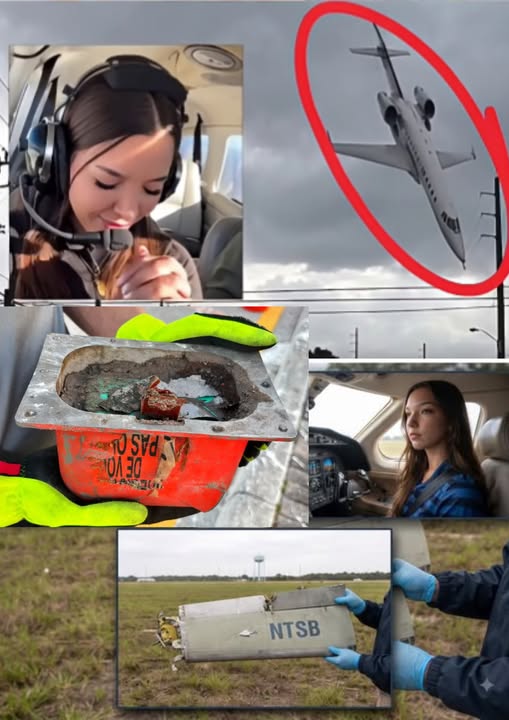
The National Transportation Safety Board (NTSB) announced on November 9 that investigators had located the aircraft’s cockpit voice recorder at the initial impact site near Greenacres, Florida.
The discovery could prove significant in determining what happened during the aircraft’s final moments, particularly as investigators continue examining reports of severe weather, dangerous turbulence and a rapidly developing emergency before the 𝔠r𝘢sh.
However, officials have not yet confirmed whether the recorder was damaged or whether its recorded information can be successfully recovered.
 THE BLACK BOX WAS FOUND AT THE INITIAL IMPACT SITE
According to the NTSB, the cockpit voice recorder was recovered from the location where the Learjet 60 initially struck the ground on November 1.
The device has since been transported to the agency’s Vehicle Recorders Laboratory in Washington, D.C., for evaluation.
Unlike the flight data recorder, which records technical information about an aircraft’s operation, the cockpit voice recorder captures sounds inside the flight deck.
Depending on the condition of the device and its recording system, investigators may be able to recover conversations between the pilots, radio communications, alarms, cockpit sounds and other audio from the flight.
This information could help investigators reconstruct the crew’s actions and understand how the emergency developed.
The NTSB has not announced when the recorder’s evaluation will be completed.
 THE FINAL RADIO TRANSMISSIONS BEFORE THE 𝔠r𝘢sh
Before the aircraft went down, the flight crew had been communicating with air traffic controllers about increasingly difficult weather conditions.
The Learjet 60 had departed Austin-Bergstrom International Airport in Texas and was traveling to North Eleuthera in the Bahamas.
While flying at approximately 35,000 feet, the crew reported icing and moderate turbulence.
They requested permission to climb to 37,000 feet in an effort to find better flying conditions.
Less than 30 seconds after receiving clearance, the situation deteriorated dramatically.
The crew declared an emergency and reported that the aircraft was descending at an alarming rate.
One of the pilots reported an overspeed condition, with the aircraft descending at more than 20,000 feet per minute.
The crew’s final radio communications captured the urgency of the situation as they struggled to regain control.
Investigators will now examine whether the cockpit voice recorder contains additional information that was not captured in air traffic control recordings.
EVIDENCE SUGGESTS THE AIRCRAFT MAY HAVE BROKEN APART BEFORE IMPACT
The recovery of the cockpit voice recorder comes after investigators discovered several aircraft components scattered miles from the main 𝔠r𝘢sh site.
Among the most significant discoveries were pieces of the left elevator, a flight-control surface located on the aircraft’s tail that helps control its pitch.
Three pieces were reportedly found approximately 1.3 to 3.8 miles from the main impact site.
Investigators also recovered components from both wings, both engines, the flight deck, stabilizers, ailerons and multiple flap track assemblies.
The location of the separated elevator components indicates that at least part of the aircraft broke away before hitting the ground.
However, investigators have not determined whether this structural separation caused the 𝔠r𝘢sh or occurred as a consequence of another event during the emergency.
The recovered components are being examined as part of the ongoing investigation.
NINE PEOPLE WERE ON BOARD — NONE SURVIVED
The November 1 𝔠r𝘢sh claimed the lives of all nine people aboard the aircraft, including two pilots and seven passengers.
Among the victims were:
- Nathalia Gadelha Filgueiras, 20: The young co-pilot who earned her pilot’s license at 17 and had dreamed of building a career in aviation.
- Adam Robinson, 45: An Austin-based technology entrepreneur.
- Helen Sharp, 40: Robinson’s wife.
- Emma, 4, and Charlie, 2: The couple’s two young children.
- Anita Maria Cetina: The family’s caregiver.
- Rachael Reed and Charmi Fehr: The other passengers aboard the aircraft.
The deaths have devastated families in Florida, Texas and beyond.
Nathalia’s father, Allan Filgueiras, previously spoke about listening repeatedly to his daughter’s final radio communications.
He said he was proud of how she continued communicating with air traffic control during the emergency, even as conditions became increasingly dangerous.
THE INVESTIGATION NOW ENTERS AN IMPORTANT STAGE
The recovery of the cockpit voice recorder marks another major step in the NTSB’s investigation.
Investigators have completed excavation work at the initial impact site and recovered numerous aircraft components for further examination.
They are expected to evaluate the recorder alongside the physical wreckage, weather information, aircraft maintenance records and communications with air traffic control.
The recorder could provide crucial insight into what the pilots discussed inside the cockpit, whether they identified a mechanical problem and how they responded as the aircraft began its rapid descent.
Still, there are important uncertainties.
Officials have not confirmed that the recorder is operational or that its recordings are recoverable. Nor has the NTSB established an official cause of the 𝔠r𝘢sh.
A complete investigation into a complex aircraft accident can take 12 to 18 months or longer.
For the families of the nine victims, the hope is that every recovered piece of evidence will help establish exactly what happened.
Among them is a father who lost his 20-year-old daughter — a young woman who had earned her wings at 17 and was already pursuing the career she loved.
The cockpit voice recorder may hold important answers. But until investigators complete their examination, the final moments of the flight remain under investigation.
Source: PEOPLE, November 10, 2026; National Transportation Safety Board (NTSB), Investigation ERA27MA026; Associated Press.