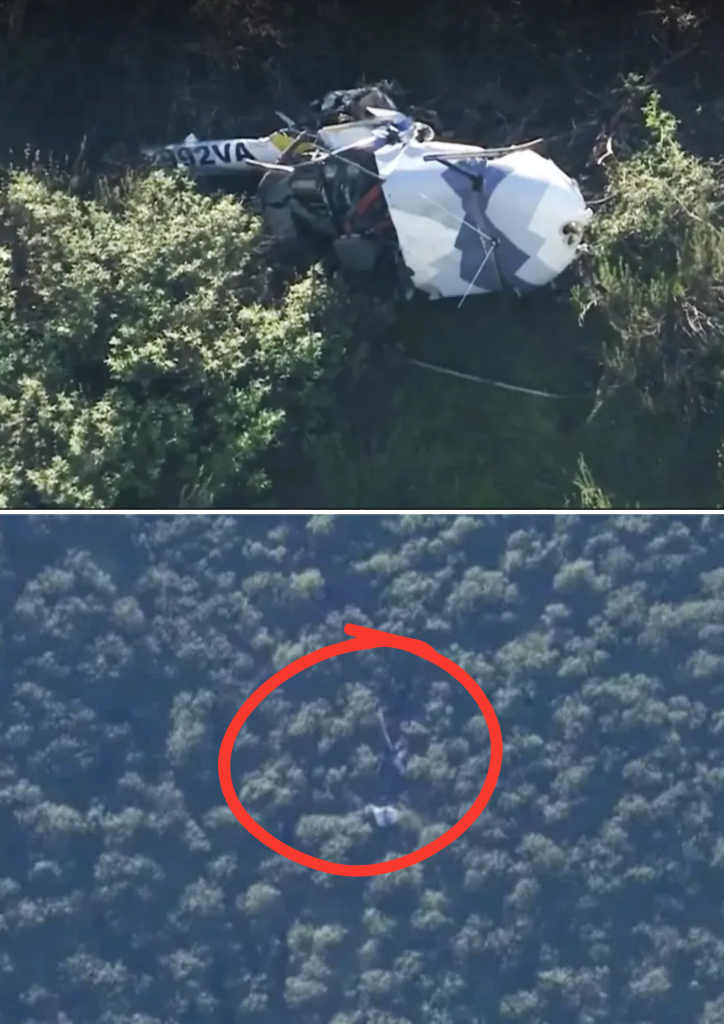
“LOOK OUTSIDE! LOOK OUTSIDE!”: FINAL RADIO CALLS REVEAL TERRIFYING MOMENTS BEFORE FLORIDA LEARJET PLUNGED TOWARD THE GROUND AT 22,000 FEET PER MINUTE
“We’re descending 22,000 feet per minute, and we’re banking 60 degrees.”
Those chilling words were among the final transmissions from the cockpit of a chartered Learjet 60 before it crashed into a roadway in Palm Beach County, Florida, 𝘬iᩚlling all nine people aboard.
Newly examined air traffic control recordings have provided a disturbing account of the aircraft’s final moments, including desperate emergency calls, warnings of an overspeed condition and a crew member repeatedly shouting for the captain to look outside.
The aircraft, registered as N722BD, crashed near Greenacres, Florida, on November 1, 2026, while travelling from Austin, Texas, to North Eleuthera in the Bahamas.
Among those killed were Captain Jeff Gregory and his 20-year-old co-pilot, Nathalia Gadelha Filgueiras.
As investigators examine the recovered cockpit voice recorder and pieces of the aircraft scattered miles from the impact site, aviation specialists are considering several possible explanations for the catastrophic loss of control.
These include severe weather, spatial disorientation, aircraft system problems and the possibility that structural damage contributed to the aircraft’s final descent.
However, investigators have not established a cause.
 THE FLIGHT THAT TURNED INTO A NIGHTMARE
The Learjet 60 departed Austin-Bergstrom International Airport at approximately 10:37 a.m. Eastern Time on November 1.
Its destination was North Eleuthera Airport in the Bahamas.
The aircraft climbed to approximately 35,000 feet and continued its journey toward Florida.
Initially, the flight appeared routine.
But as the jet approached Florida, the crew began reporting increasingly difficult weather conditions.
According to information presented by the National Transportation Safety Board (NTSB), the pilots reported moderate turbulence and light clear icing.
The outside temperature was approximately minus 47 degrees Celsius.
The crew told air traffic control that they were managing the icing but experiencing moderate turbulence.
They also asked whether a smoother flight path was available.
The controller indicated that conditions should improve as the aircraft entered different airspace.
Shortly afterward, the pilots reported encountering precipitation and requested permission to climb to 37,000 feet.
Air traffic control approved the request.
But within seconds, the situation changed dramatically.
 “MAYDAY, MAYDAY!” — THE DESCENT BEGINS
Publicly available air traffic control recordings capture the increasingly desperate communications between the aircraft and the controller.
The crew suddenly reported an unexpected descent.
Their first emergency transmission included the words:
“Mayday, mayday. We’re descending 10,000 feet per minute.”
The controller acknowledged the emergency.
But the situation was deteriorating rapidly.
The crew then declared an emergency and reported that the aircraft was experiencing an overspeed condition.
They said the jet was descending at approximately 20,000 feet per minute.
For comparison, ordinary commercial aircraft descents are generally measured in hundreds or a few thousand feet per minute, depending on the circumstances.
A descent at 20,000 feet per minute represents an extraordinary loss of altitude.
The controller responded by giving the crew discretion over their altitude and asking what assistance they needed.
The pilots were now facing an emergency that appeared to be unfolding faster than they could control.
Then came another terrifying transmission.
“We’re going to 𝔠r𝘢sh into the ground,” one of the crew members said.
The recording captured a scream.
The air traffic controller attempted to reassure the pilots.
“I’m here with you. Talk to me.”
But the aircraft continued plunging.
“WE ARE BANKING 60 DEGREES”
One of the most significant moments in the recording came when the crew described the aircraft’s position.
“We are descending 22,000 feet per minute, and we are banking 60 degrees.”
The statement indicated that the aircraft was experiencing an extremely steep descent while also turning sharply.
A bank angle of 60 degrees is substantial, particularly when an aircraft is already experiencing a serious loss of control.
The aircraft’s exact attitude and flight-control inputs cannot be established from the radio transmission alone.
But the words provide investigators with an important piece of evidence about what the crew believed was happening.
Seconds later, another voice could be heard shouting:
“Look outside! Look outside!”
The speaker appeared to be directing the other pilot’s attention beyond the cockpit instruments.
Then came another desperate exclamation:
“Holy f***, we’re out of time!”
The transmission ended.
The controller continued calling the aircraft, but there was no further response.
The Learjet crashed shortly afterward near Military Trail in the Greenacres area.
WHO WERE THE TWO PILOTS?
The aircraft was commanded by Captain Jeff Gregory, an experienced professional pilot whose dєatᩚh was confirmed by his former employer, East Coast Jets.
His co-pilot was Nathalia Gadelha Filgueiras, just 20 years old.
Nathalia’s story has attracted particular attention because of how young she was when she began pursuing her aviation ambitions.
She reportedly earned her pilot’s licence at just 17.
Her achievement had previously been highlighted in a local news feature, documenting her early passion for flying and her determination to pursue a career in aviation.
At 20, she was already working as a professional co-pilot aboard a business jet.
The final radio recording has brought renewed attention to her role during the emergency.
Her repeated instruction to look outside has become one of the most discussed details of the recording.
However, without the cockpit voice recorder analysis and additional flight data, it is impossible to determine precisely what she was seeing or what prompted her warning.
COULD SPATIAL DISORIENTATION HAVE PLAYED A ROLE?
One of the possibilities being discussed by aviation specialists is spatial disorientation.
This is a dangerous condition in which pilots lose an accurate sense of an aircraft’s position or movement.
It can occur when visual references are limited, particularly at night or in clouds, heavy precipitation and other poor-weather conditions.
The human body’s balance system can sometimes provide misleading information during unusual aircraft movements.
A pilot may believe the aircraft is flying straight and level when it is actually banking, turning or descending.
Instruments are therefore essential for maintaining an accurate understanding of the aircraft’s attitude.
In the Florida 𝔠r𝘢sh, the crew had reported turbulence, icing and precipitation before the sudden descent.
The instruction to look outside has led to questions about whether one pilot was attempting to regain visual awareness of the aircraft’s position or draw attention to something outside the cockpit.
But this remains a hypothesis.
The recording alone cannot establish that either pilot experienced spatial disorientation.
Investigators will need to examine the cockpit voice recorder, aircraft systems and available flight data before reaching any conclusions.
THE POSSIBILITY OF STRUCTURAL FAILURE
Another important line of investigation concerns the possibility that parts of the aircraft separated before impact.
During the early investigation, the NTSB confirmed that significant components of the Learjet had been recovered away from the main 𝔠r𝘢sh site.
Among them was a substantial portion of the aircraft’s left elevator.
The elevator is an important flight-control surface located on the tail.
It helps control the aircraft’s pitch, allowing the nose to move up or down.
Investigators found portions of the left elevator approximately 1.3 to 3.8 miles from the main impact location.
NTSB officials confirmed that at least some aircraft components had separated before the aircraft struck the ground.
But there is an important distinction.
Investigators have not determined whether the elevator separated because of an initial mechanical or structural failure, or whether extreme aerodynamic forces during the descent caused it to break away.
That difference could be crucial.
If a structural problem occurred first, it might help explain why the crew suddenly lost control.
Alternatively, if the aircraft entered an uncontrolled descent before the components separated, the damage could have been a consequence rather than the original cause.
At this stage, neither explanation has been established.
WHAT THE FLIGHT DATA REVEALS
Flight-tracking information has provided another important part of the investigation.
Data examined by Flightradar24 shows that the Learjet was cruising at high altitude before entering a steep right-hand descent.
The aircraft’s final recorded altitude was approximately 8,750 feet.
The tracking data also showed a rapid increase in its descent rate, with reported vertical speeds eventually exceeding 32,000 feet per minute in some recorded data.
The crew’s radio reports of 10,000, 20,000 and then 22,000 feet per minute provide additional context.
However, investigators caution that different sources of flight information measure different things.
Ground speed is not the same as airspeed, and publicly available tracking data cannot independently establish the aircraft’s precise bank angle or control inputs.
The information must be examined alongside physical wreckage, weather records and onboard recordings.
THE BLACK BOX HAS BEEN RECOVERED
Perhaps the most important development came on November 9.
The NTSB confirmed that investigators had recovered the aircraft’s cockpit voice recorder (CVR) from the location of the initial impact.
The device was transported to the NTSB Vehicle Recorders Laboratory in Washington, D.C., for evaluation.
The recovery was significant because investigators had initially been uncertain whether the recorder had remained aboard the aircraft during its final flight.
The CVR can potentially provide a detailed account of conversations and sounds inside the cockpit.
Investigators may be able to establish what the pilots discussed, whether warning alarms sounded and how the crew responded to the emergency.
However, a cockpit voice recorder does not provide video of what the pilots were seeing outside.
It must also be distinguished from a flight data recorder, which records technical information about aircraft performance and systems.
The condition of the recovered device and the availability of usable recordings are important factors in determining how much additional information investigators can obtain.
The NTSB has not announced a final cause of the accident.
NINE LIVES LOST IN A DEVASTATING 𝔠r𝘢sh
All nine people aboard the Learjet were killed.
The passengers included a family of four: Adam Robinson, Helen Sharp and their two young children, Emma, four, and Charlie, two.
Three other passengers were also among those who died.
The aircraft struck a roadway near a residential community, creating a huge crater and scattering debris across the surrounding area.
One person on the ground sustained a leg injury.
Hundreds of residents were evacuated from nearby mobile homes as emergency crews responded and investigators began recovering wreckage.
The tᩚraɢedy has left families and the wider community mourning the victims.
THE QUESTIONS INVESTIGATORS STILL NEED TO ANSWER
The final radio transmissions have provided an extraordinary glimpse into the crew’s desperate struggle.
But they have also raised more questions.
Why did the aircraft suddenly enter such a violent descent?
Did the weather and icing conditions contribute to the loss of control?
Did the pilots experience spatial disorientation?
Did a mechanical or structural problem occur before the aircraft began descending?
And did the separation of the left elevator contribute to the emergency, or was it caused by the extreme forces experienced during the fall?
These are questions that cannot be answered by dramatic audio recordings or flight-tracking graphics alone.
The NTSB must bring together the cockpit voice recorder, recovered aircraft components, weather information, maintenance records and technical flight data.
Until that work is completed, the precise chain of events remains unknown.
For now, the final words from N722BD remain haunting: “Look outside! Look outside!”
A desperate warning from a cockpit in crisis — and a final transmission that investigators will be working to understand as they piece together what happened in the skies above Florida.