“BANKING 60 DEGREES, DESCENDING 22,000 FEET PER MINUTE” — AVIATION EXPERTS EXAMINE TERRIFYING FINAL MOMENTS BEFORE FATAL FLORIDA LEARJET 𝔠r𝘢sh
Newly released air traffic control recordings have revealed the terrifying final moments aboard a Learjet 60 that crashed in Florida, 𝘬iᩚlling all nine people on board. Twenty-year-old co-pilot Nathalia Gadelha Filgueiras repeatedly urged the captain to look outside as the aircraft plunged toward the ground. Investigators are now examining whether severe weather, spatial disorientation or a possible structural failure contributed to the disaster.
The final radio transmissions from a doomed private jet have raised disturbing questions about what happened inside the cockpit moments before the aircraft crashed into a residential area in South Florida.
On November 1, 2026, a chartered Learjet 60, registered as N722BD, crashed near Greenacres in Palm Beach County, Florida, 𝘬iᩚlling all nine people aboard.
Among the victims was 20-year-old co-pilot Nathalia Gadelha Filgueiras, a young pilot who had earned her pilot’s license at just 17 years old.
The aircraft was traveling from Austin, Texas, to North Eleuthera in the Bahamas when it encountered increasingly dangerous weather conditions.
As the situation deteriorated, the crew reported ice accumulation, moderate turbulence and rapidly changing flight conditions.
What followed was a terrifying emergency that unfolded in little more than a minute.
Publicly available air traffic control recordings captured the crew’s desperate attempts to communicate with controllers as the aircraft entered an uncontrolled descent.
The recordings have since become a central part of the investigation into one of South Florida’s most devastating aviation accidents.
 THE FINAL RADIO CALLS: “WE’RE GOING TO 𝔠r𝘢sh INTO THE GROUND”
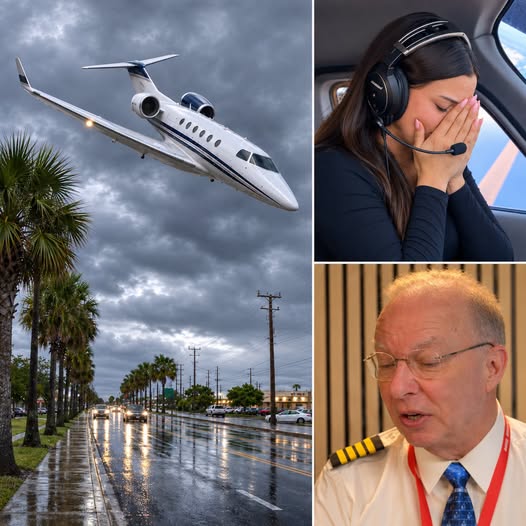
At approximately 12:47 p.m. local time, Nathalia was communicating with Miami air traffic controllers while the Learjet was cruising at approximately 35,000 feet.
Initially, her voice sounded relatively calm.
She reported that the aircraft was experiencing light clear icing and moderate turbulence.
The outside air temperature was approximately minus 47 degrees Celsius.
The crew also reported that turbulence was causing altitude fluctuations of several hundred feet.
Nathalia asked whether the aircraft could expect smoother conditions ahead.
“If you have any better ride, let us know,” she told the controller.
The controller responded that conditions should improve as the aircraft entered another area of airspace.
However, the crew soon reported precipitation and requested permission to climb to 37,000 feet.
Air traffic control approved the climb.
Less than 30 seconds later, the situation changed dramatically.
The aircraft began descending instead of climbing.
Nathalia transmitted an urgent emergency call:
“Mayday, mayday! We’re descending 10,000 feet per minute!”
Moments later, she reported an even more alarming development.
“We are in an overspeed condition descending 20,000 feet per minute!”
An overspeed condition means an aircraft is traveling faster than its permitted operating speed.
The controller responded that the crew could choose their altitude and asked what assistance they needed.
But the situation was rapidly becoming uncontrollable.
“We’re gonna 𝔠r𝘢sh into the ground,” Nathalia transmitted.
Then came another chilling report.
“We are descending 22,000 feet, and we are banking 60 degrees.”
The statement referred to an extraordinary descent rate of approximately 22,000 feet per minute, accompanied by a steep bank angle.
In the background, the captain, 55-year-old Jeffrey Gregory, could reportedly be heard reciting what sounded like the Lord’s Prayer.
Nathalia then repeatedly shouted:
“Look outside, Jeff! Look outside!”
Her final recorded words included an anguished exclamation:
“Holy [expletive], we’re out of time!”
The transmission ended.
Air traffic controllers repeatedly attempted to re-establish contact with the aircraft, but no further response was received.
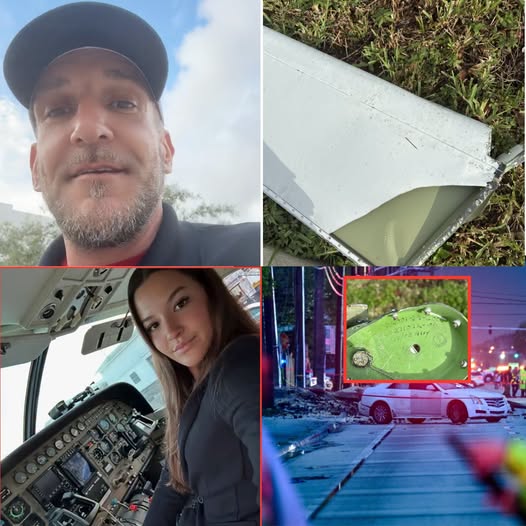 WHO WAS NATHALIA GADELHA FILGUEIRAS?
Behind the frightening recording was a young woman whose aviation journey had begun years before the tᩚraɢedy.
Nathalia Gadelha Filgueiras was just 20 years old and lived in Boca Raton, Florida.
She graduated from West Boca Community High School, which has an aviation and aerospace academy.
Her passion for flying developed early, and she earned her pilot’s license at just 17, even before obtaining her driver’s license.
She documented aspects of her aviation journey on social media, sharing experiences from her time in the air.
According to reporting about her training, Nathalia had accumulated more than 1,300 flight hours and completed specialized training to qualify for the Learjet.
Her father, Allan Filgueiras, is also an experienced pilot who helped introduce his daughter to aviation.
Following the 𝔠r𝘢sh, he spoke publicly about his daughter’s abilities and the devastating loss his family was facing.
He described Nathalia as exceptionally talented and defended her professional qualifications amid online criticism about her age.
In an interview with ABC News, he said listening to his daughter’s final radio transmissions was extremely painful.
However, he also heard something else in those recordings: her determination to keep communicating and trying to manage an increasingly desperate situation.
Her father said he wanted answers about what caused the aircraft to lose control.
For him, the investigation is not simply about understanding an aviation accident. It is about finding out why his daughter never came home.
TWO POSSIBLE EXPLANATIONS: SPATIAL DISORIENTATION OR STRUCTURAL FAILURE
Aviation specialists examining the publicly released recordings and available wreckage information have discussed several possible explanations.
Two areas of particular interest are spatial disorientation and a potential structural failure.
Neither has been established as the cause of the 𝔠r𝘢sh.
1. Spatial disorientation: Could the pilots have lost their sense of orientation?
Spatial disorientation occurs when a pilot’s brain receives misleading information about the aircraft’s position or movement.
Inside clouds, heavy precipitation or darkness, pilots may experience sensations that do not accurately reflect the aircraft’s actual attitude.
The body’s vestibular system, located in the inner ear, can be particularly vulnerable to these illusions.
A pilot may feel level while the aircraft is banking, or struggle to recognize a developing descent.
This can become especially dangerous when visibility is poor and the aircraft is experiencing severe turbulence.
Nathalia’s repeated instruction to the captain to “look outside” has attracted attention because it could reflect an attempt to regain visual orientation.
However, that interpretation remains speculative.
The available recording does not establish exactly what either pilot could see through the cockpit windows or what instruments were showing at that moment.
2. Possible structural failure: Did part of the aircraft break away?
Another important investigative question involves the possibility that the Learjet suffered structural damage during the emergency.
NTSB investigators reported evidence suggesting that the aircraft may have begun breaking apart before hitting the ground.
Particularly significant was the recovery of sections of the left elevator, a component attached to the aircraft’s tail that helps control its pitch.
Three pieces of the left elevator were recovered at locations approximately 1.3 to 3.8 miles from the main 𝔠r𝘢sh site.
A damaged or separated elevator could seriously affect an aircraft’s ability to maintain stable flight.
However, investigators have not determined whether the elevator separated before the aircraft lost control or whether it broke apart because of the extreme forces experienced during the descent.
That distinction is ᑕriᩚtiᩚcal.
If a structural component failed first, it could have contributed to the loss of control. If it separated during the descent, it might instead have been a consequence of another problem.
The NTSB is examining the recovered components to establish the sequence of events.
ICING, TURBULENCE AND A POWERFUL THUNDERSTORM
Weather conditions are another major focus of the investigation.
Before the emergency, the crew reported light clear icing and moderate turbulence at approximately 35,000 feet.
The outside temperature was around minus 47 degrees Celsius.
Ice accumulation can alter airflow over an aircraft’s wings and control surfaces, increasing drag and potentially reducing aerodynamic performance.
Severe turbulence can also place substantial forces on an aircraft’s structure.
Earlier in the flight, air traffic control had warned the crew that the requested route toward Freeport could take them into an area of significant precipitation.
The crew maneuvered around the weather before continuing toward the Bahamas.
As conditions changed, they reported precipitation and requested a higher cruising altitude.
The emergency began shortly after that request was approved.
Investigators will need to examine weather radar information, aircraft performance data, maintenance records and the recovered wreckage to determine whether icing, turbulence, structural damage or a combination of factors contributed to the 𝔠r𝘢sh.
NTSB RECOVERS COCKPIT VOICE RECORDER IN WASHINGTON INVESTIGATION
One of the most important developments came on November 9, when the National Transportation Safety Board confirmed that investigators had recovered the aircraft’s cockpit voice recorder.
The device was located at the initial impact site and transported to the NTSB Vehicle Recorders Laboratory in Washington, D.C.
The recorder is particularly important because it may contain conversations between the captain and co-pilot that were never transmitted over the public radio frequency.
Investigators hope the recording will help establish:
- What the pilots discussed as weather conditions deteriorated.
- Whether either pilot identified a problem with the aircraft’s flight controls.
- What warnings or alerts appeared in the cockpit.
- Whether the crew attempted emergency procedures.
- What happened immediately before the aircraft struck the ground.
The cockpit voice recorder is different from the air traffic control recordings already released publicly.
The latter capture communications between the crew and controllers. The cockpit recorder may provide additional information about the conversations and sounds inside the flight deck.
As of November 27, the NTSB had not published a definitive interpretation of the recorder’s contents or announced a probable cause.
NINE PEOPLE LOST THEIR LIVES IN THE DEVASTATING 𝔠r𝘢sh
The Learjet crashed near South Military Trail in the Greenacres area of Palm Beach County.
The aircraft struck a residential area close to a mobile home community, creating a large impact crater and scattering debris across the surrounding area.
All nine people aboard were killed, including both pilots and seven passengers.
The victims included technology entrepreneur Adam Robinson, his wife Helen Sharp, their two young children, Emma and Charlie, as well as passengers Rachael Reed, Rowan “Charmi” Fehr Toews and Ana Maria Ramirez Cetina.
The tᩚraɢedy devastated families and friends and left the local community struggling to understand how a private flight could end in such catastrophic circumstances.
HER FATHER IS STILL SEARCHING FOR ANSWERS
For Allan Filgueiras, the loss of his daughter has been almost impossible to comprehend.
He has publicly described Nathalia as a gifted pilot and said he wants investigators to explain why the aircraft continued into dangerous weather conditions.
He has also questioned the decisions made during the flight and hopes the investigation will provide a clearer understanding of what happened.
His grief is compounded by the fact that the final radio transmissions have been made public, allowing the world to hear his daughter’s voice during the emergency.
He has described listening to those recordings as extremely painful.
Yet he continues to wait for the NTSB’s findings.
THE INVESTIGATION IS FAR FROM OVER
The 𝔠r𝘢sh investigation, identified as ERA27MA026, remains ongoing.
Investigators have recovered major aircraft components, including sections of both wings, both engines, the flight deck, vertical and horizontal stabilizers, the left elevator and multiple control-surface assemblies.
Some components have been transported to laboratories for further examination.
The cockpit voice recorder is also undergoing evaluation.
For now, the available evidence raises serious questions but does not establish whether the 𝔠r𝘢sh resulted from spatial disorientation, severe weather, a structural failure or several factors occurring together.
What is certain is that the aircraft experienced an extraordinarily rapid descent, the crew declared an emergency, and all nine people aboard lost their lives.
For Nathalia’s father, the recordings preserve the final moments of a daughter who had dreamed of flying since childhood.
She was only 20 years old.
And the questions surrounding her final flight remain unanswered.