“HE THOUGHT HE HAD ESCAPED… BUT A POLICE DRONE WAS WATCHING HIS EVERY MOVE!” — London Phone Thief, 18, Caught Stealing on Camera Before Motorcycle Officer Knocks Him Off His E-Bike — Then a Stranger Delivers the Final Surprise on Chelsea Bridge!
LONDON, ENGLAND — NOVEMBER 19, 2026
He was speeding through the crowded streets of central London on a powerful electric bike, snatching mobile phones from unsuspecting pedestrians before disappearing into traffic.
He believed his speed would help him escape.
But high above the busy streets, something was following him.
A Metropolitan Police drone.
And its cameras were recording everything.
The suspect, 18-year-old Wesley Rodrigues, had already been linked to a series of phone thefts when police launched the drone to locate him.
What followed was a dramatic pursuit through some of London’s busiest streets.
The drone captured Rodrigues stealing another phone while officers watched the footage in real time.
Police then directed a motorcycle officer toward his location.
On Chelsea Bridge, the officer used his motorcycle to knock Rodrigues off his electric bike.
But the teenager wasn’t finished trying to escape.
He jumped up, ran from officers and threw a large kn!fe into the River Thames — before an unexpected intervention from a passerby brought his escape to an end.
The entire operation took just 15 minutes.
Metropolitan Police+1
THE PHONE THIEF WHO DIDN’T REALIZE POLICE WERE WATCHING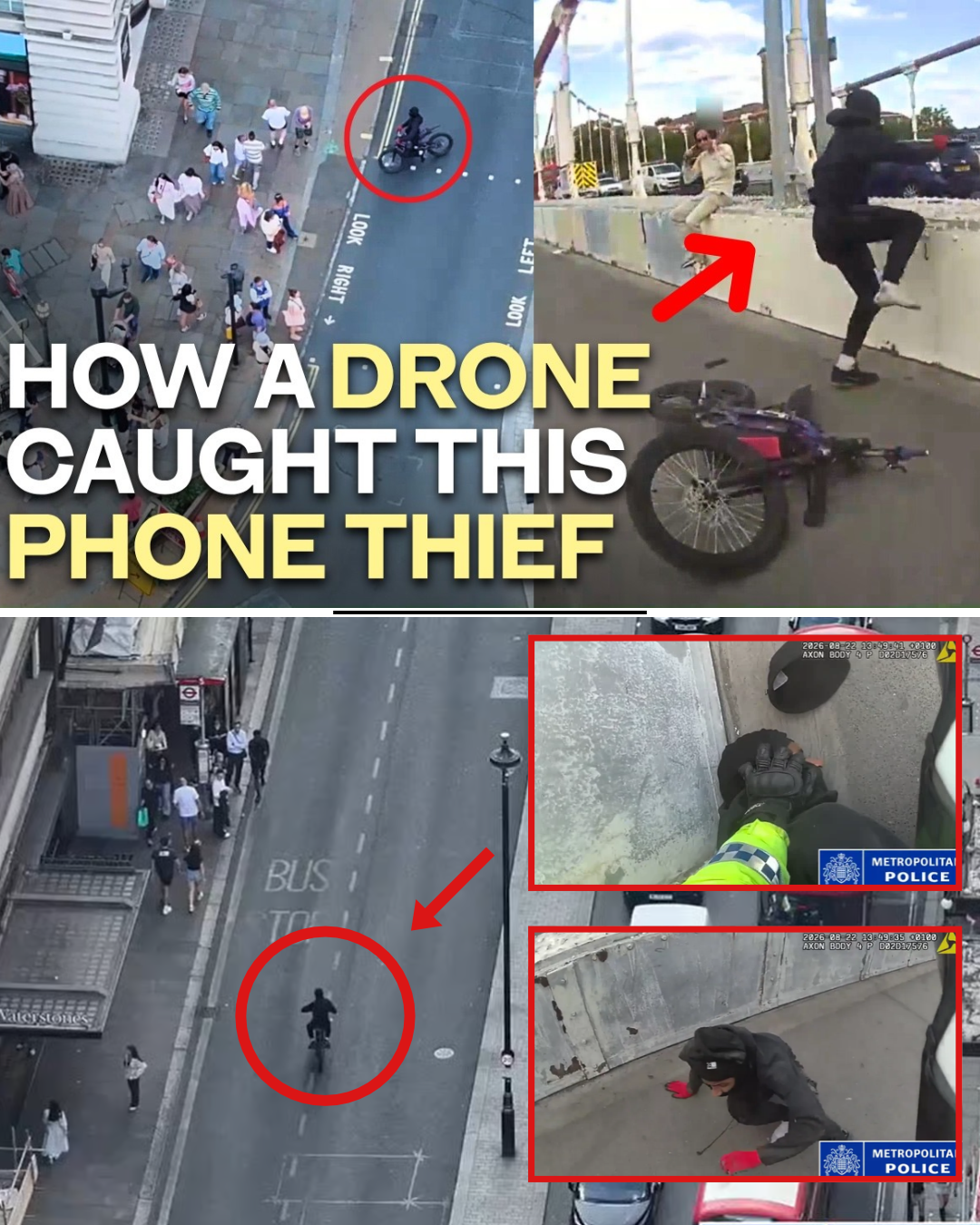
The extraordinary pursuit began on August 22, 2026.
Multiple pedestrians across central London had reported having their phones snatched by someone riding an electric bike.
Police were searching for the suspect when specialist drone operators were called into action.
At precisely 1:34 p.m., a police drone was deployed over central London.
Within moments, operators identified Rodrigues riding a powerful Sur-Ron electric bike near Piccadilly.
He was dressed in black and wearing distinctive bright red gloves.
From above, officers could follow his movements while he traveled through busy streets and along crowded pavements.
Then the cameras recorded something that immediately confirmed their suspicions.
Rodrigues approached another pedestrian and snatched a mobile phone — unaware that the entire incident was being captured from the sky.
The footage provided officers with real-time evidence and allowed them to coordinate the pursuit without losing sight of him.
HE WEAVED THROUGH TRAFFIC — BUT THE DRONE NEVER LOST HIM
Rodrigues continued riding through central London, navigating around pedestrians and moving between vehicles.
Police footage showed him making sudden turns, mounting pavements and traveling dangerously close to members of the public.
At one point, he was seen weaving between two pedestrians.
In another moment, he approached a busy bus stop and grabbed a phone before accelerating away.
The drone continued following him as he traveled toward Victoria and Chelsea Bridge.
Officers on the ground received updates about his location.
Unlike a traditional pursuit, where a suspect might escape by turning into a side street, the drone provided a continuous overhead view.
Rodrigues could change direction, accelerate or disappear behind buildings — but the officers monitoring the aerial footage could continue tracking his movements.
The coordinated operation was bringing police closer to him with every passing minute.
ITV News London
THEN A MOTORCYCLE OFFICER MADE HIS MOVE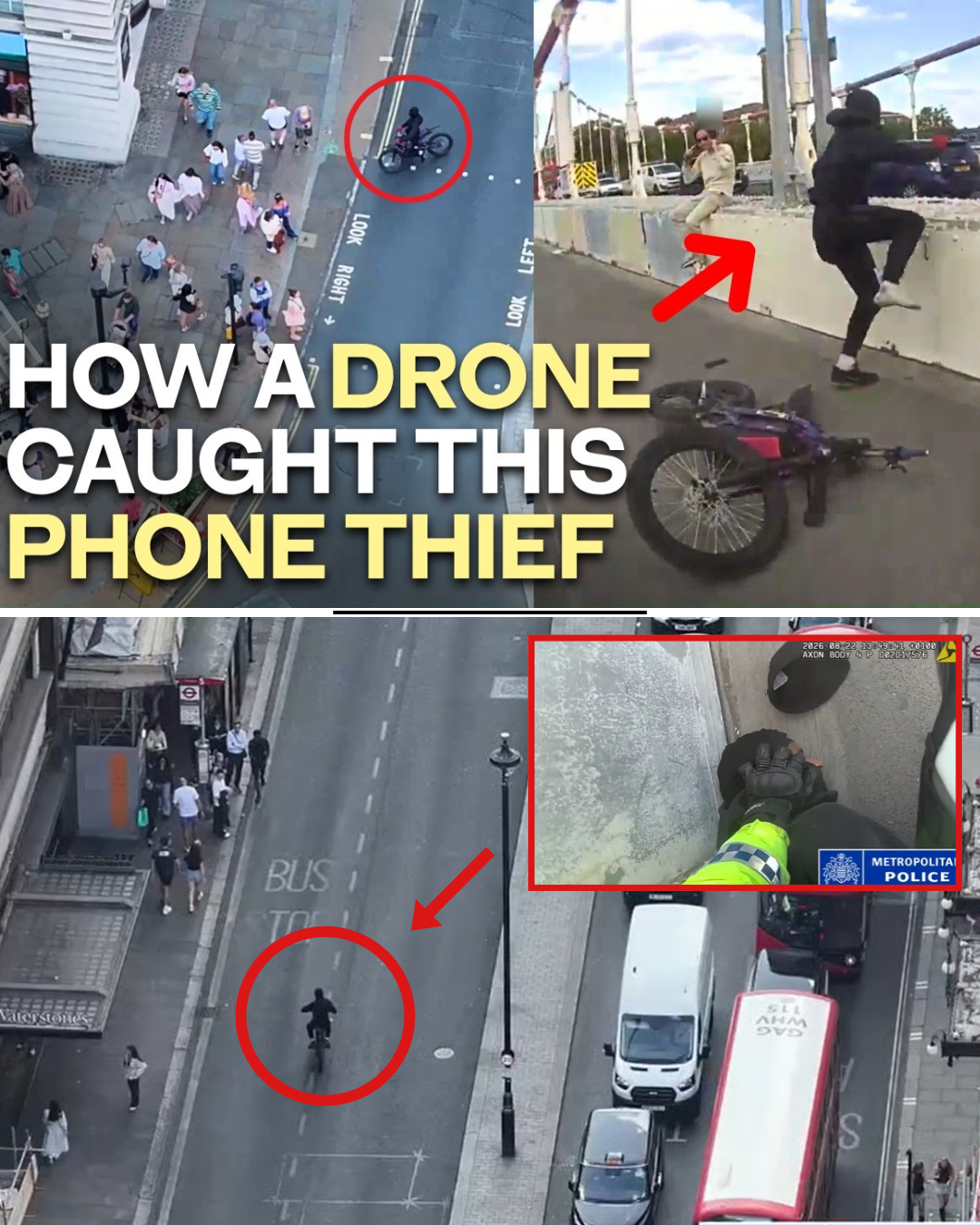
As Rodrigues approached Chelsea Bridge, a Metropolitan Police motorcycle officer moved into position.
The suspect was still riding his electric bike.
The police drone continued monitoring the situation.
Then the officer used a tactical interception, bringing his motorcycle into contact with Rodrigues’ bike.
The impact knocked the teenager from his vehicle.
For a moment, it appeared the pursuit might be over.
But Rodrigues immediately got up.
He abandoned his electric bike and began running.
During the foot chase, he discarded a large zombie-style kn!fe into the River Thames.
Police later confirmed that he had been carrying the bladed item during the thefts.
His defense lawyer said the w𝔢𝔞𝔭𝔬η had not been used against any of the victims.
Nevertheless, officers were pursuing a suspect who had been riding dangerously through crowded streets while carrying an offensive w𝔢𝔞𝔭𝔬η.
And despite being knocked off his bike, Rodrigues was still trying to get away.
THE STRANGER WHO HELPED END THE CHASE
The final moments of the pursuit unfolded on Chelsea Bridge.
As officers chased Rodrigues on foot, a member of the public stepped in.
The passerby tripped the fleeing teenager.
Rodrigues stumbled, allowing officers to catch up and detain him.
At 1:49 p.m., police arrested him.
Just 15 minutes had passed since the drone first identified him near Piccadilly.
During that brief period, the drone had tracked his movements, captured another theft and guided officers to the location where he could be intercepted.
The stolen phones were recovered and returned to their owners.
The footage, subsequently released by the Metropolitan Police, showed the extraordinary combination of aerial technology, motorcycle policing and assistance from a member of the public.
Metropolitan Police
BUT THE VICTIMS’ STORIES REVEALED SOMETHING EVEN MORE DISTURBING
The thefts were not simply about the financial value of the stolen phones.
At Rodrigues’ sentencing, prosecutors described the emotional and practical consequences suffered by his victims.
One woman had type 1 diabetes.
Her mobile phone was connected to medical devices that helped manage her condition, including an insulin-delivery system and a glucose monitor.
When Rodrigues stole the phone, she lost access to an important part of her medical monitoring setup.
She was forced to spend money on taxis and missed a theater performance while trying to recover the device.
Another victim described feeling frightened and deeply shaken.
A third said the experience left her anxious about visiting large cities.
For the victims, the thefts lasted only seconds — but the consequences continued long after Rodrigues had ridden away.
A COURTROOM REVEALS HIS EXTENSIVE CRIMINAL HISTORY
Rodrigues appeared before Southwark Crown Court after pleading guilty to theft, dangerous driving and possession of an offensive w𝔢𝔞𝔭𝔬η.
During the proceedings, the court heard that he had eight previous convictions involving 30 offenses.
His history became an important consideration during sentencing.
Prosecutors described his dangerous riding through central London, including traveling on pavements and putting pedestrians at risk.
Judge Nicholas Rimmer reviewed the evidence, including police body-camera footage.
The judge described the footage as 𝘴h☉𝔠king.
He also criticized the fear caused by Rodrigues’ actions and the danger his behavior posed to the public.
On November 16, 2026, Rodrigues was sentenced to 18 months in a young offender institution.
He was also disqualified from driving for three years and 39 weeks.
ITV News London
THE DRONE THAT CHANGED THE ENTIRE PURSUIT
Following the sentencing, Metropolitan Police officials highlighted the importance of the drone operation.
Detective Constable Maria Archer said Rodrigues had repeatedly targeted vulnerable pedestrians and endangered the public through his reckless actions.
She credited the drone operators and ground officers with identifying, tracking and arresting him quickly.
Deputy Assistant Commissioner James Harman also emphasized the role of drone technology in improving police responses.
The Metropolitan Police have been testing a program called Drones as First Responder, which allows drones to reach incidents quickly and transmit live footage to control rooms.
During a major trial, drones attended more than 2,300 incidents.
In approximately three-quarters of those cases, they arrived before officers on the ground.
Officials said the technology could help track suspects, locate missing people and provide valuable information during emergencies.
The Rodrigues case offered a particularly striking demonstration.
A suspect who might otherwise have escaped through busy London streets was located, monitored and arrested in just 15 minutes.
ONE E-BIKE. FIVE STOLEN PHONES. A POLICE DRONE — AND AN ESCAPE THAT ENDED ON CHELSEA BRIDGE
The dramatic footage tells the story of a pursuit that unfolded both on the streets and in the sky.
An 18-year-old rode through central London stealing phones.
A police drone located him near Piccadilly.
Its cameras captured another theft.
Officers tracked him toward Chelsea Bridge.
A motorcycle officer knocked him from his electric bike.
Rodrigues ran, discarded a kn!fe into the Thames and attempted to escape.
Then a passerby intervened.
And within moments, officers had him in custody.
What makes the footage remarkable is not simply the speed of the arrest.
It is the way modern surveillance technology and officers on the ground worked together to bring a dangerous pursuit to an end.
For the victims, the arrest meant their phones could finally be recovered.
For investigators, the footage provided compelling evidence of Rodrigues’ actions.
And for the teenager who had been speeding through London’s streets, the consequences were significant.
He thought his electric bike could carry him away from police. But the one thing he couldn’t outrun was already flying above him.
Fifteen minutes after the drone spotted him, Wesley Rodrigues was in handcuffs. Three months later, he was sentenced to 18 months in detention.